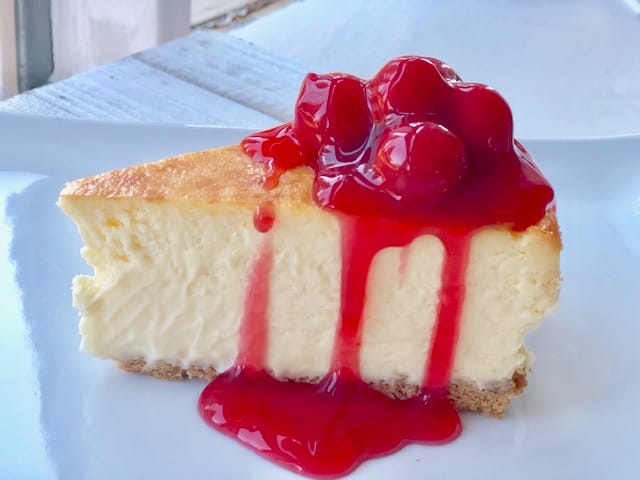
The One and Only New York Cheesecake You'll Ever Need! 🍰
The classic New York cheesecake that's stood the test of time—creamy, rich, and absolutely foolproof with the right technique.
When it comes to cheesecake, there are so many fun ways to experiment—no-bake, flavored, or in bar form—but for the classic New York-style cheesecake, this recipe stands the test of time. Creamy, rich, and perfectly smooth, this cheesecake doesn't mess around!
The trick? It's all about temperature control and technique. Starting at a higher temp gives it that beautiful puffed texture, while a slow, low finish ensures it stays luscious without cracks. No flour needed—just cream cheese, eggs, and a touch of citrus zest for that classic flavor.
This cheesecake has a rich history, from its origins in New York's iconic Lindy's Deli to your kitchen today. A little tip: always chill your cheesecake for at least 12-16 hours to get those perfect, sharp cuts. It's all about patience and precision, but the result? Totally worth the wait!
Serve it up with your favorite toppings (I love a good cherry pie filling), and get ready to wow your guests at your next potluck or dinner party. This truly is a dessert that never disappoints.
Pro Tip: Use an instant-read thermometer to check for doneness—between 148° and 152°F is the sweet spot!
I test recipes and techniques relentlessly. I cut this cheesecake into slices after waiting a certain number of hours. This picture here is after 18 hours of chilling time. As you can see, the cut is a lot more precise than very first picture which was sliced after only 12 hours.
New York cheesecake has a rich and fascinating history that goes back to the early 20th century. While cheesecake itself has ancient origins, the New York-style cheesecake we know today, with its dense, cream cheese-based filling, was first created in the 1920s. Arnold Reuben, a German-Jewish immigrant and New York restaurateur, is credited with developing the first version of this cake. However, it was Lindy's Deli that truly popularized it, serving a version so iconic that it became a culinary staple.
Ingredients
- 1 ¾ cups graham cracker crumbs
- pinch of kosher salt
- 7 tbsp butter, melted
- 3 tbsp sugar
- 5 blocks cream cheese, room temp
- 1 tbsp vanilla
- 1 ½ tsp lemon rind* see note (or simply 1 tbsp lemon juice)
- 1 ½ tsp orange rind* see note
- ¼ tsp kosher salt
- 1 ¾ cups plus 1 tbsp sugar
- 5 eggs, straight from the fridge
- 2 egg yolks, straight from the fridge
- ¼ cup cream (or sour cream for more zing, mix it up!)
- Suggested topping: canned cherry pie topping
Instructions
- 1
Preheat the oven to 325°F (160°C). Combine graham cracker crumbs, melted butter, 3 tablespoons (45ml) sugar and a pinch of salt and mix until blended with a fork. Press the mixture into the bottom of a lightly greased 9-inch (23cm) springform pan. Bake for 10 minutes. Remove from the oven and let cool completely before filling.
- 2
Increase the oven temperature to 450°F (230°C). Set the rack where your cheesecake will bake on the lower third of the oven. Set another rack under it and place a large baking sheet or pan filled with water; this will be your "cheater" water bath that will ensure the top of your cheesecake doesn't crack. I found this "cheater" water bath is just as effective as a more traditional and riskier water bath (which sometimes tends to seep into your cheesecake).
- 3
In the bowl of your stand mixer, add room temperature cream cheese and beat on medium speed (starting on low) for 3 minutes. Stop to scrape the sides of the bowl, and at that point add the vanilla, salt, lemon and orange rind (or lemon juice—see note). Mix on low speed, and when mixed, turn the speed up to medium and beat for another 3 minutes.
- 4
Add the sugar all at once and beat on medium speed for 2 minutes. Again, ensure you scrape the sides of your bowl.
- 5
This next step is used by pastry chefs to achieve the flawless texture of the cheesecake. Place a fine-mesh sieve over your cheesecake bowl and place the eggs and egg yolks in it. With a rubber spatula, press and whisk the eggs until they pass through the sieve; discard the clot-like bits that remain. It may seem impossible at first, and you may think the eggs will never pass through, but trust the process with a bit of patience, and they will! It's important to mix the batter on low speed for a minute or two, as mixing on higher speed would aerate the batter too much, and these air bubbles may contribute to cracks. I've attached a picture of what's left behind in a fine-mesh sieve. Doesn't look appetizing, does it? This step ensures that all of those "clots" with the unpleasant textures don't make it into your cheesecake.
- 6
Again, stop and scrape down the sides of your bowl with a rubber spatula. Add the cream and mix on low speed for just another minute until combined. Pour the batter into the prepared cooled crust and place it in the oven for 15 minutes. You are looking for the cheesecake to puff and brown. If the cheesecake did not brown similar to my picture, give it another 5 minutes. Then reduce the oven temperature to 250°F (120°C) and continue baking for another 55–70 minutes (65 for me).
- 7
Friends, this next note is very important. This is such a technical cheesecake, using the temperature extremes to create a certain texture. The digital instant-read thermometer is an absolute must for this recipe. Testing for doneness by jiggling and touching just won't work to produce consistently reliable results. The cheesecake looks very similar in appearance and feels very similar at 30, 45, and 60 minutes of baking time. You are looking to reach a temperature of between 148°F and 152°F (64–67°C) measured in the middle of your cheesecake. The cake in the picture registered 150°F (66°C), and I found it perfect. At anywhere over 155°F (68°C), in my opinion, the texture suffers.
- 8
When baked, turn the oven off, leave the door of the oven wide open, and pull out the racks gently so the cheesecake is almost on the outside of the oven. This will facilitate the cooling process, while the residual heat from the oven will make the process more gradual, which will prevent cracks. After about 20 minutes, run a clean thin butter knife between the cheesecake and the springform pan. This will help your cheesecake settle nicely and be easier to remove later. After an hour at room temperature, cover your cooled cheesecake with plastic wrap and place it in the fridge to chill.
- 9
Now comes the hardest part. Wait. And wait a while. My suggestion is overnight—ideally 16 hours, but at least 8–12 hours. We are not just looking to cool the cheesecake. We are looking to give this delicate cheesecake sufficient time to set!
- 10
When ready to serve, run a thin sharp knife under hot water, wipe it with a paper towel (do so after each cut), and slice your cheesecake. Top with the topping of your choice and enjoy! I suggest canned cherry pie filling. As much as I don't like pre-made canned things—it just works here!
FAQ
Did you try this recipe?
Leave a star rating — it helps other cooks find it!
Comments


Looking for more? Explore the full collection — filter by lifestyle, cuisine, or dietary needs.