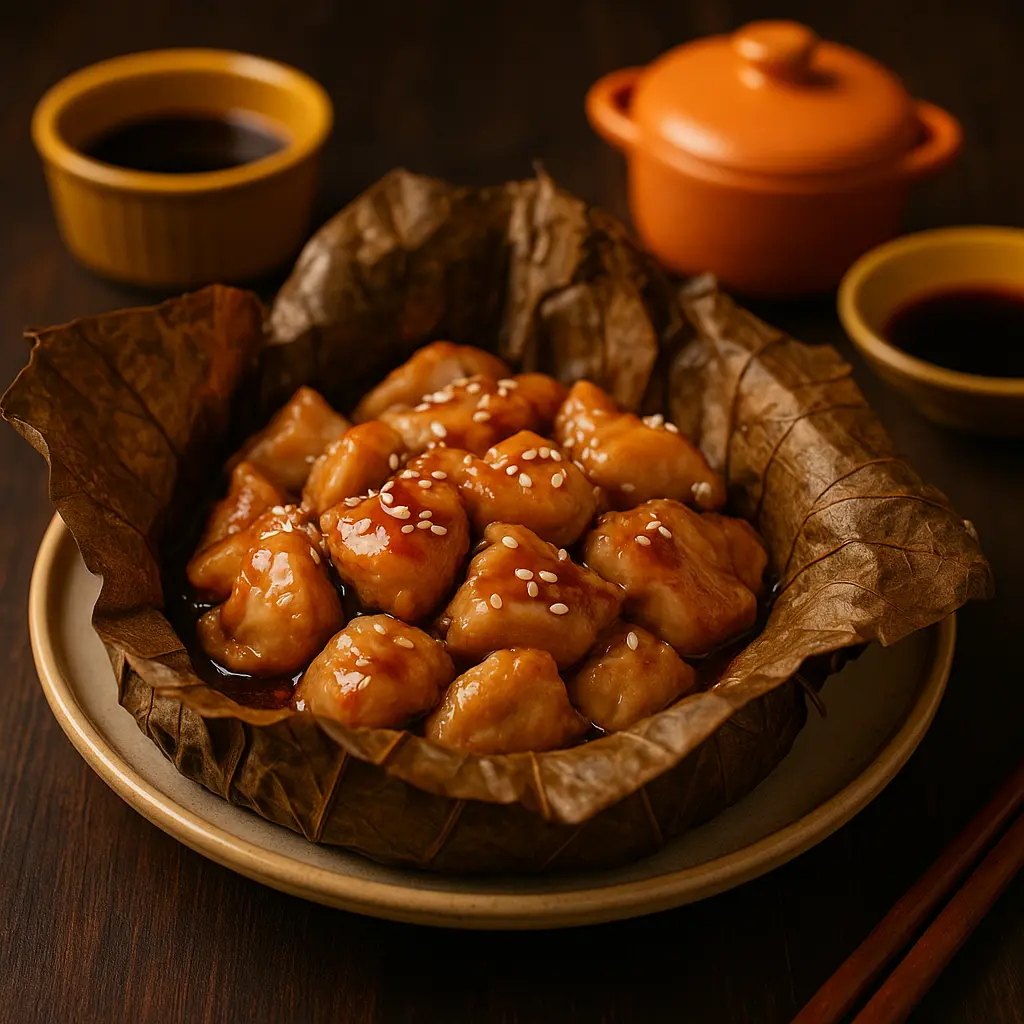
Steamed Chicken in Lotus Leaf (荷叶鸡)
Fragrant, tender steamed chicken wrapped in lotus leaves with soy, garlic, and Shaoxing wine. A dim sum–style recipe perfect for home cooks and special dinners.
The Flavor of What Never Browns
In much of North American cooking, we are taught to trust the same signs of deliciousness.
We trust sizzle. We trust smoke. We trust the deepening color of onions in a pan, the browned edge of roast chicken, the dark crust on a steak, the toasted, caramelized, crackling evidence that heat has done its work. We are trained, almost instinctively, to look for the Maillard reaction as proof of seriousness, proof of flavor, proof that a dish has become worthy of attention.
And yet some of the most hauntingly delicious foods in the world never brown at all.
They do not hiss or char or emerge from the oven with swagger. They come to life more quietly than that. Through steam. Through perfume. Through the slow exchange between leaf and meat, mushroom and sauce, ginger and wine. Through enclosure. Through moisture. Through patience. They do not seize your attention with force. They draw you in with atmosphere.
Steamed chicken in lotus leaf is one of those dishes.
It is not the sort of preparation that announces itself in a North American kitchen. There is no dramatic crust, no bubbling cheese, no lacquered skin. At first glance, it might even seem too restrained to impress those of us raised to associate flavor with fire and spectacle. But that would be a failure of imagination. Because this dish is not built on the logic of browning. It is built on the logic of infusion. It understands that intensity can come not only from heat applied directly, but from what is held in, wrapped up, allowed to circulate and deepen in its own fragrant world.
That, to me, is one of the great beauties of many Asian cooking traditions: they do not depend on a single definition of deliciousness.
They know that flavor can be dark and resonant without being roasted. That tenderness can be luxurious without being braised for hours. That aroma can do as much emotional work as caramelization. That a dish can be subtle in method and still arrive at the table with enormous presence.
Lotus leaf chicken embodies all of that.
The leaf itself feels almost theatrical before the cooking even begins—large, veined, pliable after soaking, ancient-looking in the best possible way, like something borrowed from a more patient culinary civilization. Wrapping food in it feels less like assembly and more like ceremony. You place the marinated chicken inside with its mushrooms, ginger, wine, soy, perhaps a few slices of Chinese sausage or chestnut if you want added richness, and then you fold. You enclose. You make a parcel, not simply for convenience, but for transformation. What happens inside that bundle is the entire point.
Steam moves differently from dry heat. It does not attack; it persuades.
Under its influence, the chicken becomes exceptionally tender, but tenderness alone is not the marvel. The marvel is the way the aromas bloom in confinement. The earthiness of shiitake. The warmth of ginger. The quiet sweetness of Shaoxing wine. The savoriness of soy and oyster sauce. And over all of it, the unmistakable fragrance of the lotus leaf itself—woody, herbal, slightly tannic, impossible to separate from the memory of the finished dish. The leaf is not a garnish. It is an ingredient in the deepest sense, not something you eat directly, but something that leaves itself behind.
I love that kind of cooking.
I love food that asks you to understand flavor as something more layered than browned equals good. I love dishes that reveal how narrow our defaults can be, how quickly we mistake familiarity for superiority. Because there is nothing lesser about steam. Nothing lacking in a dish whose greatness comes from aroma rather than crust. If anything, this style of cooking feels more mysterious, more refined, more confident. It does not need to shout with char. It does not need to prove itself with blaze and blackening. It already knows what it is doing.
And when served, it has a kind of quiet drama that no browned food can replicate.
A lotus parcel arriving at the table is not just dinner; it is an invitation. Sometimes I serve it family-style, opening the leaves so the fragrance escapes all at once, filling the room with something dark, savory, and transporting. Other times, I prepare individual parcels so that each person gets their own. I especially love serving it that way, each leaf opened on its own plate like a small unfolding journey, a private entrance into another culinary language. There is something deeply satisfying about watching someone encounter that first rush of steam, that first glossy bite of tender chicken, and realizing that this dish, despite its lack of browning, is anything but delicate in flavor. It is deep. It is saturated. It is memorable.
It is, in its own way, a showstopper.
Not because it glitters. Not because it is loud. But because it feels complete. It carries with it mood, fragrance, tenderness, and the kind of sensual specificity that lingers in the mind long after the meal is over. It reminds us that beauty in food does not always come from crispness or color or contrast. Sometimes beauty arrives wrapped in something dark and crinkled, opened at the table in a cloud of scented steam.
Perhaps that is why I keep returning to dishes like this one.
They expand the palate, yes, but they also expand the imagination. They remind us that cooking is never only about technique; it is about worldview. About what a culture chooses to prize. About whether flavor is chased through flame or through fragrance, through crust or through softness, through directness or through patience. And the Asian kitchen, again and again, offers some of the most profound lessons in that regard. It teaches that a dish can be full of depth without ever being browned. That mystery can be delicious. That steam, in the right hands, is not the absence of drama but its own kind of revelation.
Steamed chicken in lotus leaf is a perfect example of that truth.
It is rich without heaviness, fragrant without fuss, deeply savory without needing a single blistered edge. It is proof that some of the world’s most compelling dishes are not built on conquest by heat, but on the gentler, older art of perfuming from within.
And once you understand that, you begin to see steaming differently.
Not as a compromise.
Not as the thing you do when you are avoiding flavor.
But as one of the most elegant ways flavor has ever been carried.Whether you're looking to recreate a restaurant memory or just want something new and comforting for dinner, this lotus-wrapped chicken will absolutely deliver.
Mga Sangkap
- 680 g boneless skinless chicken thighs, cut into large chunks
- 2–3 dried lotus leaves (soaked and softened)
- 6 dried shiitake mushrooms (rehydrated, sliced)
- 4 slices ginger
- Optional: 2–3 slices Chinese sausage (*lap cheong*), cut on bias
- Optional: chestnuts (for texture and body)
- 15 ml light soy sauce
- 15 ml oyster sauce
- 15 ml Shaoxing wine
- 5 ml dark soy sauce (for colour)
- 5 ml sesame oil
- 3 g cornstarch
- 3 ml sugar
- 1 ml white pepper
- 1 clove garlic, minced
Mga Tagubilin
Lotus Leaves
1Prep the lotus leaves: Soak them in hot water until soft and pliable (20–30 minutes), then rinse and pat dry. Trim off any tough edges if needed. You can overlap 2 leaves if they are small.
Chicken Marinade
2Marinate the chicken: Combine the chicken with the marinade and sliced mushrooms. Let sit for at least 30 minutes, or up to overnight.
Assembly
3Assemble the parcels: Lay a lotus leaf flat. Place 1 portion of chicken (with mushrooms, optional sausage, etc.) in the centre. Fold the leaf over tightly into a square parcel (like wrapping a burrito). Tie with kitchen string if desired.
Steaming
4Steam the parcels: Place them in a steamer basket or on a rack over boiling water. Steam for 35–40 minutes with the lid on, until the chicken is fully cooked and infused with fragrance. Serve over rice, sprinkle with green onions, sesame seeds, and maybe a light drizzle of oyster sauce.
FAQ
Na-try mo ba ang resipe na ito?
Mag-iwan ng star rating — nakakatulong ito sa ibang nagluluto na mahanap ito!
Mga Komento
Naghahanap pa? I-explore ang buong koleksyon — i-filter ayon sa lifestyle, cuisine, o dietary needs.