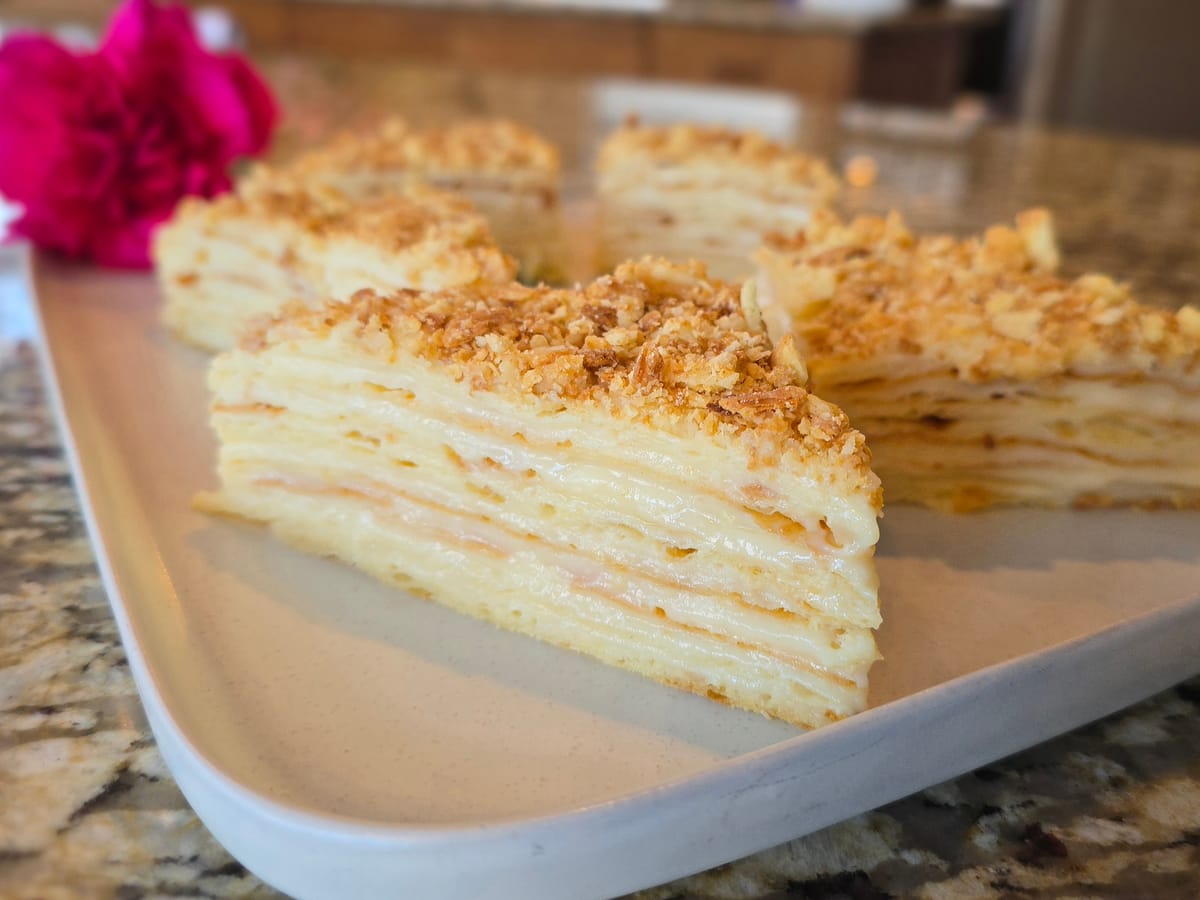
Napoleon Torte
Classic Russian cake made with flaky puff pastry and rich pastry cream! Delicious!
A classic Russian cake made with flaky puff pastry and rich pastry cream! Delicious!
Ingredients
- 4 1/2 cups (562g) all-purpose flour
- 5 sticks plus 2 TBSP (567g) unsalted butter, cold
- 2 eggs
- 1 tsp fine salt
- 1.5 TBSP (22 ml) lemon juice
- 1 cup less 1 TBSP (227 ml) cold water
- 4 cups (960 ml) milk
- 2 vanilla beans, optional
- 4 whole eggs
- Pinch of salt
- 2/3 cup (83g) all-purpose flour
- 1 1/2 cups (300g) sugar
- 2 TBSP (28g) butter, cold, unsalted (to add to hot custard)
- 1 TBSP (15 ml) vanilla extract
- 2 1/2 sticks (284g) unsalted butter, softened, for buttercream
- 3 TBSP (24g) powdered sugar for garnishing the cake
Instructions
- 1
Beat the eggs with a fork. Add the lemon juice and salt and whisk well. Add the water and whisk until well combined. Refrigerate until needed.
- 2
Grate the butter directly into the flour. Toss it to ensure the butter is well coated with flour. Make a small well in the middle and pour in the prepared liquid. Mix the flour and butter mixture into the liquid with a fork. Then, using your hands, quickly form everything into dough. Don't overmix it; work with it gently. Combine it by folding the dough over and over again like a letter (to create those delicate layers) rather than just kneading it. I like to fold it like a letter at least 4 times (roll it out into a rectangle, fold, repeat). Form it into a block, cover with plastic wrap, and refrigerate for at least two hours before rolling it out and baking it; but I prefer refrigerating it overnight. Alternatively, instead of forming a block, you can divide the dough into 12 portions and roll them into balls. Then refrigerate for at least two hours. You will be rolling each of these balls into about 8–9 inch (20–23cm) circles.
- 3
Divide the pastry into 3 portions (2 equal and 1 smaller portion). Divide the two equal portions in half. You will now need to roll out 4 layers about 3mm thick. For me, it worked out to 10½ x 14 inch (27 x 36cm) layers (yours might be slightly smaller or larger).
- 4
Preheat your oven to 400°F (200°C). Start by rolling out two layers, dab them gently with a wet towel, and prick all over with a fork. Place them onto half sheets and bake two sheets at a time for about 20–22 minutes. Halfway through baking, rotate the baking sheets (the top one can now go to the bottom rack and the bottom can go to the top rack) to ensure even baking. When you can lift the pastry with a fork and it doesn't bend, and when the pastry is flaky and a nice golden brown in colour, you know it's done. If you rolled your dough into 12 balls, each one will bake less—maybe about 10 minutes. Be sure to cut out the exact cake circle using an 8 or 9 inch (20 or 23cm) cake pan as your guide. Be sure to bake the pieces you cut off as well; those will be used for cake garnish.
- 5
While the layers are baking, roll out the other two layers. Repeat Step 4.
- 6
Roll out the last layer (the uneven one) to any size you like, keeping it at about 3mm thick. Repeat Step 4, but bake it for about 30 minutes—this will be used for crumbs to garnish the cake. We want it firmer and more golden, which is why we'll bake it longer. Allow all layers to cool completely.
- 7
Split the vanilla bean in half, if using. Scoop out the seeds with a butter knife and add them to the milk. Warm the milk in a saucepan until steaming and small bubbles are just starting to form. It shouldn't boil.
- 8
In a bowl, whisk together the sugar, flour, and salt. Then add the whole eggs and whisk them into a thick pale paste, for about 4–5 minutes. Make sure the ingredients are well combined.
- 9
Carefully ladle the hot milk a bit at a time into the egg mixture, whisking constantly. It's important to add the milk slowly while whisking non-stop; otherwise your eggs will scramble. Gradual heat tempering is key. Switch back between adding more milk and whisking the custard.
- 10
Pour everything back into the saucepan you used to heat the milk and cook over medium heat, whisking constantly and being careful to scrape the bottom and corners of the pan; this should take about 3–5 minutes. When large bubbles start to appear and the custard has thickened into a thick pudding-like consistency, reduce the heat to low simmer for 30 seconds or so, then remove the pan from heat.
- 11
Strain the pastry cream into a bowl through a fine mesh sieve. Add the butter and vanilla and stir aggressively until melted and combined. Allow it to cool for about 5 minutes. Then cover the pastry cream with plastic wrap directly against its surface to prevent a skin from forming on top. Cool at room temperature until cool, just over an hour.
- 12
Beat the softened butter (it has to be really soft, nearly the consistency of sour cream) in a stand mixer. Start adding the custard 1 tbsp (15ml) at a time while beating on medium-high, ensuring it's fully incorporated before adding the next tablespoon. When all the custard is added, beat on high for a minute or two. You have now made your buttercream!
- 13
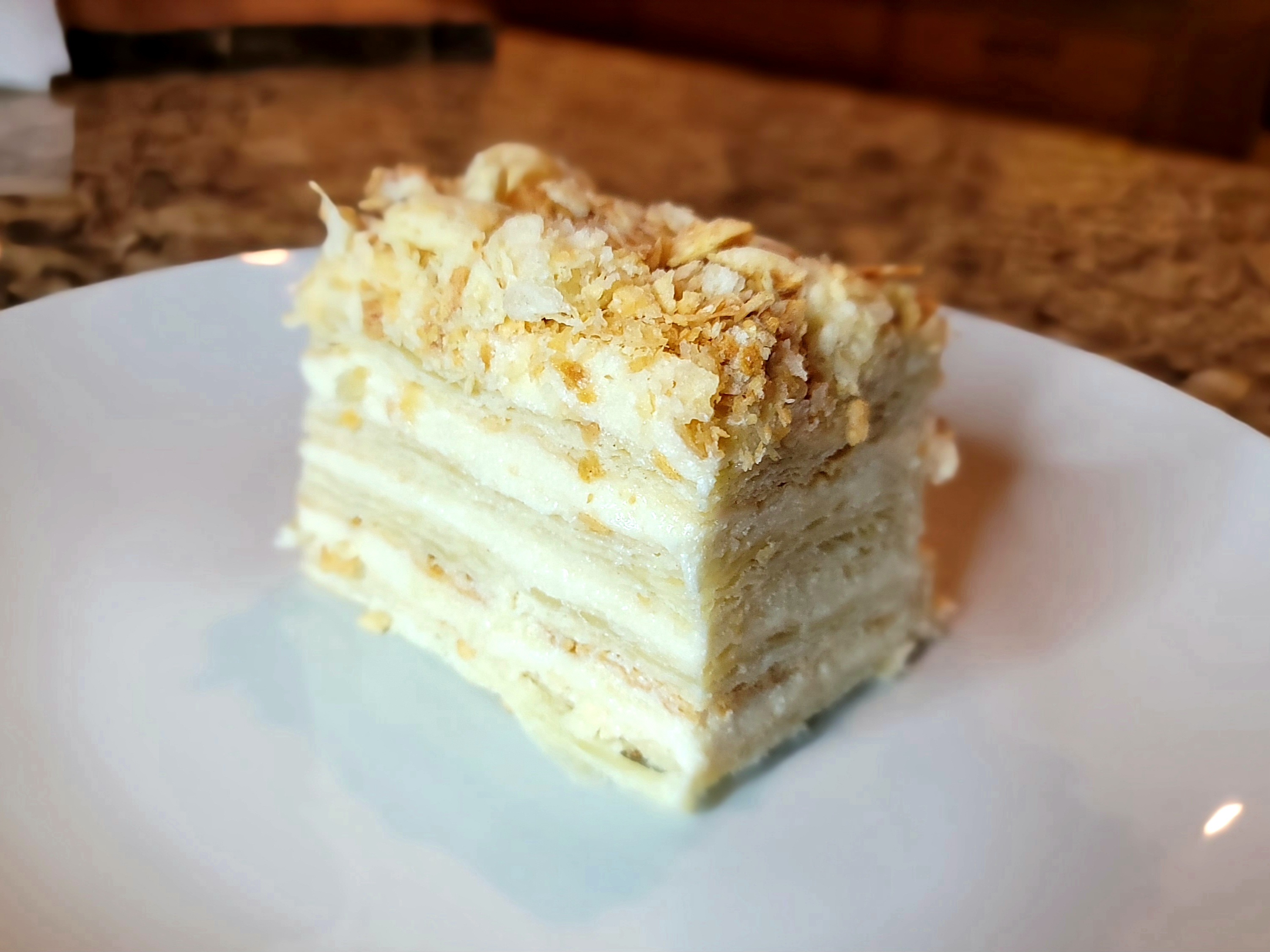
Now for the fun part—assembling your torte! Place the first pastry layer on a large cutting board or cake base. Using a spatula, spread about 1/5 of the buttercream evenly over the layer. Place the second pastry layer on top and repeat, smoothing the buttercream between each layer. Continue with the remaining two pastry layers, adding buttercream between each one until all four layers are stacked. Use the remaining buttercream to coat the top and sides of the torte, smoothing it with your spatula for an elegant finish. You can also pipe some decorative swirls on top if you'd like.
- 14
Break up the extra golden pastry layer you baked in Step 6 into crumbs and toss with the powdered sugar. Generously sprinkle these sweetened crumbs over the top and sides of the torte, pressing them gently so they adhere to the buttercream. Refrigerate the cake for at least 12 hours or ideally overnight for it to be soft and moist and to ensure the cake layers absorb the buttercream beautifully. I like letting this cake come to room temperature for an hour before serving, but serving straight from the fridge also works well. Enjoy!
FAQ
Did you try this recipe?
Leave a star rating — it helps other cooks find it!
Comments



Looking for more? Explore the full collection — filter by lifestyle, cuisine, or dietary needs.