軟綿綿北海道牛奶麵包(生吐司風格)
用湯種製作的北海道牛奶麵包,軟綿綿、濕潤嫩滑——無論做烤吐司定三文治都係一流。呢款日式生吐司做法簡單,喺屋企都可以輕鬆焗出嚟。
The Architecture of Softness
There are breads that announce themselves with crackle.
They arrive with shattering crusts, flour-dusted bravado, and the rustic confidence of something torn apart at the table. They are proud of their chew, their char, their rough edges. And then there is Hokkaido milk bread, which seeks almost the opposite ideal. It is not trying to be dramatic in that familiar Western way. It is pursuing something rarer, and in many ways more difficult: perfect softness. Not weakness, not blandness, not the featureless pillowy texture of industrial bread, but a cultivated, deliberate, deeply considered tenderness. A loaf so fine-crumbed, so light, so supple that it feels less baked than composed.
That is the beauty of shokupan.
It is bread that has made gentleness into an art form.
The first time you encounter a truly good milk bread, what surprises you is not sweetness, though there is a little of that, nor richness, though it is certainly enriched. What surprises you is the texture: the way the crumb seems to pull apart in long, delicate strands; the way it compresses under your fingers and springs back; the way it manages to be airy and substantial at the same time. It does not merely sit on the plate. It yields. It sighs. It almost seems to resist the ordinary language we use for bread, because so much of bread vocabulary is built around toughness and crust and hearth and bite, while this loaf belongs to another tradition altogether—one that prizes moisture retention, feathery structure, and the serene luxury of a perfectly even crumb.
To make a bread like this at home is to realize how much technique is hidden inside apparent simplicity.
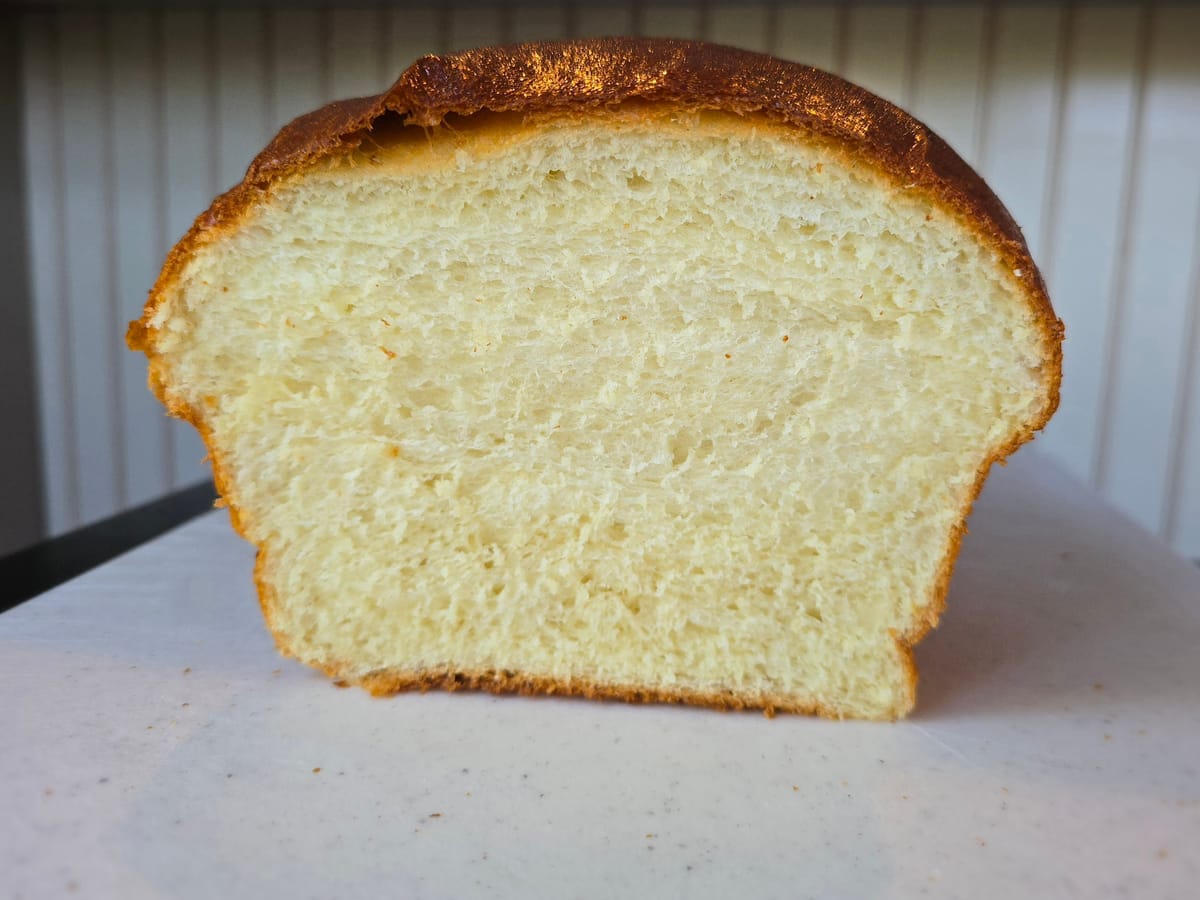
A loaf of Hokkaido milk bread can look almost modest from the outside: gently domed, bronzed, glossy with egg wash, its beauty understated. But inside it carries an astonishing amount of thought. This is not accidental softness. It is engineered softness. Designed softness. Softness built layer by layer, choice by choice, in ways that reveal just how sophisticated bread can become when the goal is not ruggedness, but refinement.
At the center of that refinement is tangzhong, one of the quiet marvels of Asian baking.
On paper, tangzhong seems almost too humble to deserve reverence: flour and liquid cooked together into a paste. But what it does to bread is transformative. By pre-gelatinizing a portion of the starch, it changes the dough’s relationship to moisture entirely, allowing the loaf to hold more water and keep it. The result is not simply softness on the day of baking, but a particular kind of softness—deep, enduring, almost creamy in its tenderness. It is the difference between bread that merely seems fluffy and bread that remains moist, elegant, and resilient long after it cools.
I love techniques like that because they reveal a deeper philosophy of cooking.
The most meaningful innovations are not always dramatic. Sometimes they are subtle interventions that alter the whole experience from within. Tangzhong does not scream for attention. It just quietly makes the bread better—more supple, more luscious, more itself. And that kind of intelligence in food always moves me. Not the noisy kind. The kind that understands structure so well it can make tenderness feel inevitable.
But tangzhong is only the beginning.
This loaf is also a lesson in enriched dough done properly, which means respecting every stage. Enough sugar and milk to soften the crumb and round out the flavor, but not so much that the bread loses its composure. Butter added after the dough begins to develop, so the gluten has a chance to organize itself before luxury enters the room. Kneading long enough to create that glossy, elastic structure that can stretch thin without tearing—because softness without strength is not milk bread; it is collapse. And then shaping, that deeply satisfying stage in which the dough is divided, rolled, folded, and tucked into neat logs, each one contributing to the final pull-apart structure of the loaf. Even before it bakes, you can feel the intention in it.
That is what sets great breads apart from merely good ones: intention you can taste.
And then there is the baking itself, which is where so many beautiful loaves are either realized or ruined. Hokkaido milk bread does not want an aggressive bake. It asks for care, for calibration, for an understanding that color alone is not the full story. Too little heat, and the crumb risks being under-set, damp, fragile. Too much, and the interior loses the very moisture and tenderness that define it. This is why I care so much about internal temperature here. A loaf baked to 195°F has maximum softness and moisture, that almost impossibly tender interior that feels luxurious and fresh. A loaf pushed to 200–203°F becomes slightly more structurally confident: cleaner to slice, more stable to store, less prone to collapse. Both approaches have merit, and that nuance matters. It turns bread baking from vague instinct into a conversation between texture and purpose.
I think that is part of why this bread feels so satisfying to make.
It rewards attention without punishing the baker with unnecessary severity. It is elegant, but it is not precious. It is highly technical, but the techniques are there in service of pleasure, not performance. Every choice leads toward the same goal: a loaf that slices cleanly, toasts beautifully, and yet is so tender fresh that the first instinct is to tear off a piece with your hands and eat it standing at the counter, still faintly warm.
And what a loaf it is.
The crust comes out thin and beautifully browned, just enough to frame the softness within. The egg-and-cream wash leaves it glossy, almost polished, as though the bread has been dressed before being sent to the table. The crumb inside is pale, close, and plush, with that unmistakable pillowy quality that makes each slice feel almost weightless. It is the kind of bread that transforms the ordinary rituals of daily life. Toast becomes more elegant. Sandwiches become more deliberate. A simple swipe of butter becomes, somehow, enough.
That may be the greatest triumph of Hokkaido milk bread: it elevates the everyday without losing its humility.
This is not special-occasion bread in the traditional sense. It is not made to sit untouched in the center of the table while everyone admires it from a distance. It is made to be lived with. Toasted in the morning. Turned into sandwiches. Eaten plain in torn strips. It belongs to the intimate category of foods that become part of a household’s rhythm, and yet it carries within it extraordinary craftsmanship. That balance—between daily usefulness and technical beauty—is one of the reasons I find it so compelling.
Because in the end, this loaf is not only about softness.
It is about what it takes to create softness well.
It is about understanding dough deeply enough to make it gentle without making it weak. It is about respecting moisture as a structural element, not just an incidental one. It is about seeing bread not as something that must always be crusty, rugged, and old-world to be worthy of admiration, but as something that can be fine-textured, polished, and profoundly comforting without sacrificing seriousness.
Shokupan knows this.
It understands that tenderness is not lesser than strength. That subtlety is not lesser than drama. That a loaf can be beautiful not because it crackles, but because it yields. And once you have made a bread like this—once you have watched those smooth dough logs rise in the pan, once you have pulled from the oven a bronzed loaf with a cloud-soft interior, once you have sliced through that delicate crumb and seen how every technical decision has translated into texture—you understand that softness, too, can be a kind of mastery.
Perhaps even the most difficult kind.
Because anyone can bake bread that shouts.
This bread whispers.
And somehow, that makes it unforgettable.They're all variations of the same enriched dough, sometimes shaped differently or branded by region. This one uses my go-to method that balances texture, moisture, and clean slicing.
材料
- 湯種:
- ¼ 杯(32克)高筋麵粉
- ¼ 杯(60毫升)全脂牛奶
- ¼ 杯(60毫升)清水
- 麵糰:
- 2½ 杯(360克)高筋麵粉(我通常由340克開始,麵糰會軟啲;但如果麵糰太黐手,就慢慢加多啲——視乎情況喺340至360克之間調整)
- ¼ 杯(50克)細砂糖
- 2¼ 茶匙(7克)即溶酵母或快速乾酵母
- 2 湯匙(15克)全脂奶粉(可省略,但建議加)
- 略少於1茶匙(5克)幼鹽
- ½ 杯(120毫升)全脂牛奶,室溫
- 1隻大雞蛋,輕輕打散
- ¼ 杯(56克)無鹽牛油,軟化
- 表面裝飾:
- 1隻雞蛋 + 1 湯匙(15毫升)鮮忌廩(蛋液,掃出光澤用)
做法
湯種
1第一步
喺小鍋裡將麵粉、牛奶同清水拌勻至無粉粒。用中火加熱,不停攪拌直到變成光滑嘅濃稠糊狀(大約2至3分鐘)。然後攤凍至室溫備用。
麵糰
2第二步
喺座枱攪拌機嘅碗裡,將高筋麵粉、砂糖、酵母、奶粉同鹽混合均勻。加入已攤凍嘅湯種、牛奶同雞蛋,用低速攪拌5分鐘,直到麵糰初步成形(呢個階段會有啲粗糙係正常嘅)。
- 3
第三步
每次加入1湯匙(15克)軟化牛油,用中速(4速)繼續攪拌5分鐘。之後繼續搓揉,直到麵糰變得光亮、順滑,而且拉開唔會斷裂——總搓揉時間大約需要10至12分鐘。如果麵糰非常黐手、唔成糰,可以每次加1湯匙(8克)麵粉,最多加到360克為止。
- 4
第四步
將麵糰搓圓,放入已塗油嘅大碗裡,用保鮮紙蓋緊。放入預熱至175°F(80°C)後已關火嘅焗爐裡,讓麵糰發酵45至75分鐘,或直到體積膨脹至兩倍大、蓬鬆為止。
整形與二次發酵
5第五步
將麵糰取出,輕輕按壓排氣。分成3等份。將每份壓扁成長方形,將兩邊長邊向中間折疊,然後緊緊捲成圓柱形。將三條麵糰接縫朝下,放入已塗油嘅9x4吋(23x10厘米)烤模裡。
- 6
第六步
用保鮮紙蓋住烤模,再次放入已關火嘅溫焗爐裡。讓麵糰再發酵45至55分鐘,直到麵糰高出烤模邊緣並呈圓頂狀,用手指輕按會慢慢回彈為止。
烘焗與冷卻
7第七步
將焗爐預熱至350°F(175°C)。輕輕喺麵包表面掃上蛋液。焗20至23分鐘,大約20分鐘時留意一下狀況。麵包內部溫度至少要達到195°F(91°C),咁樣烤出嚟嘅麵包芯會濕潤、熟透。我自己通常焗到203°F(95°C),大約需要20至21分鐘。195°F(91°C)嘅內部溫度可以保持最大濕潤度,但200至203°F(93至95°C)焗出嚟嘅麵包結構更紮實,唔容易塌陷、壓縮或變濕底,特別係如果你打算儲存或切片嘅話。
- 8
第八步
麵包喺烤模裡焗好後,先放置5分鐘再取出,然後放喺晾架上完全攤凍先切片。最好喺2日內食完,或者放入冰箱冷凍保存更耐。
常見問題
你試過這個食譜嗎?
留下星級評分,幫助其他人發現這個食譜!
留言


想搵更多靈感?瀏覽完整食譜庫——按飲食風格、菜系或飲食需要篩選。